Mobility in train station (Malmö C)
2024 – 5 Weeks timespan
Group of 4
Interactive Crowd Visualisation.
This project explored the intersection of public mobility, behavioral psychology, and interaction design through an adaptive, data-driven installation at Malmö Central Station. The goal was to subtly guide pedestrian flow by visualising crowd density and movement patterns in real time, capitalising on innate human tendencies like herd behavior.
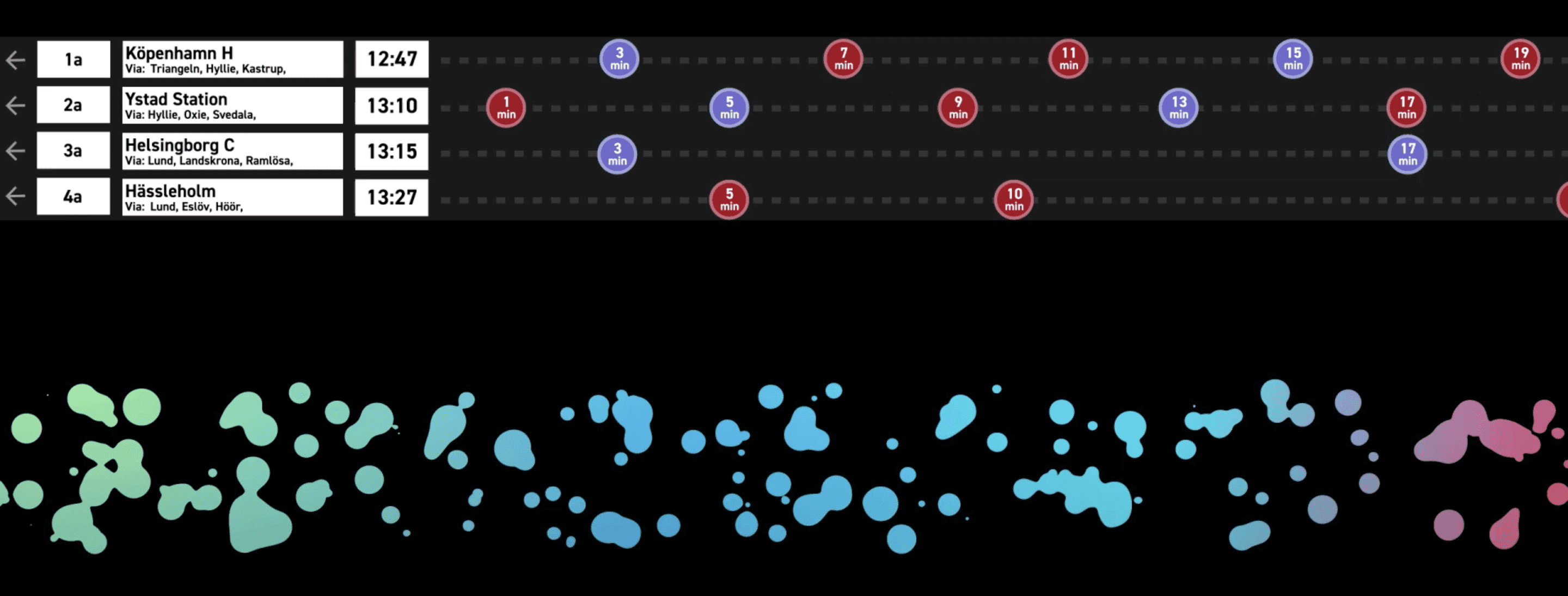
Our interactive system comprised two primary elements: a dynamic visual display reflecting crowd presence and speed, and a real-time train tracker providing a functional navigation aid. Together, these elements enhanced both the commuter experience and the spatial behavior within the station, facilitating smoother pedestrian transitions through passive behavioral cues.
Process
The early phases focused on ideation informed by behavioural research—specifically the social dynamics of “herd mentality.” Our conceptual framework assumed that real-time visual feedback on crowd conditions could influence individual movement, reducing congestion organically.
We developed sketches, scenario maps, and spatial studies, evaluating station infrastructure constraints such as furniture layout and visibility. After determining interaction zones, we shifted to prototyping.
The system was designed to track people entering the station, detect movement speed, and generate responsive animations on a mounted screen. These visuals intensified with greater crowd density, signalling peak flow moments and gently encouraging better navigation decisions.
Prototyping involved both digital and physical elements. We simulated data input via Arduino sensors and developed animated representations of the station’s crowd flow. While technical challenges, especially Arduino integration, delayed progress, we restructured our workflow into focused task groups to maintain momentum.
Tools Used
Arduino: Used for motion detection and crowd speed measurement.
Adobe Suite & Procreate: Visualisation sketches and animations.
iMovie: Video prototyping and walkthrough documentation.
Collaborative Platforms: Google Drive and Miro for team coordination.
Physical prototyping materials: Used to visualise screen placements and pedestrian sightless.
Result
The prototype demonstrated how interactive visualisation can reduce confusion and enhance wayfinding in crowded public environments. By leveraging crowd psychology and responsive design, the installation proposed a calm, visually engaging solution to a typically stressful experience. Future iterations would improve sensory integration, scale the display system, and deepen interactivity through responsive lighting or audio elements.
Mobility in train station (Malmö C)
2024 – 5 Weeks timespan
2024 – 5 Weeks timespan
Group of 4
Group of 4
Interactive Crowd Visualisation.
This project explored the intersection of public mobility, behavioral psychology, and interaction design through an adaptive, data-driven installation at Malmö Central Station. The goal was to subtly guide pedestrian flow by visualising crowd density and movement patterns in real time, capitalising on innate human tendencies like herd behavior.
Our interactive system comprised two primary elements: a dynamic visual display reflecting crowd presence and speed, and a real-time train tracker providing a functional navigation aid. Together, these elements enhanced both the commuter experience and the spatial behavior within the station, facilitating smoother pedestrian transitions through passive behavioral cues.
Process
The early phases focused on ideation informed by behavioural research—specifically the social dynamics of “herd mentality.” Our conceptual framework assumed that real-time visual feedback on crowd conditions could influence individual movement, reducing congestion organically.
We developed sketches, scenario maps, and spatial studies, evaluating station infrastructure constraints such as furniture layout and visibility. After determining interaction zones, we shifted to prototyping.
The system was designed to track people entering the station, detect movement speed, and generate responsive animations on a mounted screen. These visuals intensified with greater crowd density, signalling peak flow moments and gently encouraging better navigation decisions.
Prototyping involved both digital and physical elements. We simulated data input via Arduino sensors and developed animated representations of the station’s crowd flow. While technical challenges, especially Arduino integration, delayed progress, we restructured our workflow into focused task groups to maintain momentum.
Tools Used
Arduino: Used for motion detection and crowd speed measurement.
Adobe Suite & Procreate: Visualisation sketches and animations.
iMovie: Video prototyping and walkthrough documentation.
Collaborative Platforms: Google Drive and Miro for team coordination.
Physical prototyping materials: Used to visualise screen placements and pedestrian sightless.
Result
The prototype demonstrated how interactive visualisation can reduce confusion and enhance wayfinding in crowded public environments. By leveraging crowd psychology and responsive design, the installation proposed a calm, visually engaging solution to a typically stressful experience. Future iterations would improve sensory integration, scale the display system, and deepen interactivity through responsive lighting or audio elements.